What do libraries contribute to their communities? It’s a question that feels easy to answer…until you try to put it into words. Is it the books? The quiet corners? The programs? The feeling of walking into a space where you’re welcome to stay a while?
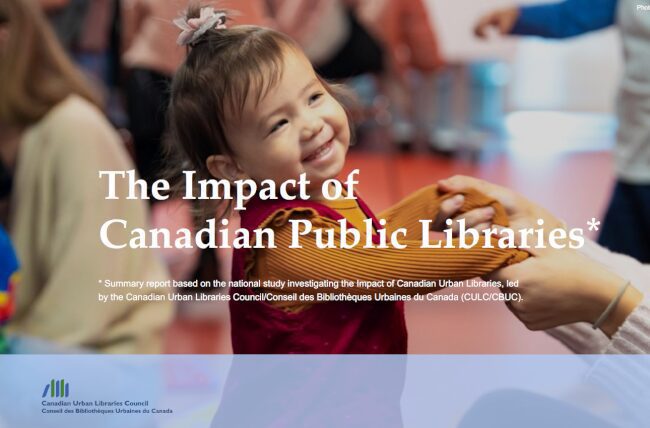
A recent national study from the Canadian Urban Libraries Council (CULC) takes a closer look, and for the first time, puts real data behind something many of us already know: libraries have a meaningful, measurable impact on people’s lives.
A clearer picture of impact
The study looked at how public libraries shape experiences across Canada, gathering responses from thousands of people across multiple library systems. What emerged is that libraries matter on three levels: to individuals, to communities, and to society as a whole.
That impact shows up in four key ways:
- Emotional — supporting well-being, comfort, and a sense of belonging
- Intellectual — helping people learn, grow, and access information
- Creative — inspiring imagination, exploration, and new ideas
- Social — building connections between people and communities
It’s a framework that captures something familiar. You might come in for a book, but leave with a new idea, a helpful conversation, or a sense that you’ve found your place for the afternoon.
The quiet power of everyday services
One of the study’s clearest findings is that, despite the many incredible programs and services on offer at modern libraries, collections still matter. In fact, they matter the most. More than 90 percent of respondents reported using library collections, whether that’s physical books, digital titles like those found in the ORL’s Digital Collection, or other materials such as our Library of Things collection. It’s a reminder that access to stories, information, and ideas remains at the heart of what libraries do.
At the same time, library programs, while used by fewer people overall, deliver some of the highest levels of patron and community impact. From early learning activities to technology help to creative workshops, these experiences often leave a lasting impression.
A space that belongs to everyone
Libraries are often described as a “third space”—not home, not work, but something equally important. The CULC study reinforces this idea, showing that libraries are widely seen as welcoming, trusted, and inclusive environments. Even among people who don’t regularly visit, there is strong support for what libraries represent. Many agree that libraries are one of the most valuable resources in their communities, and that children should grow up with access to them. That sense of shared ownership matters. It’s what allows libraries to serve as gathering places, learning hubs, and spaces where people can simply exist without expectation.
Meeting people where they are
Another key finding: libraries don’t have a single audience. They support newcomers navigating unfamiliar systems, parents building early literacy at home, young people exploring identity and creativity, and communities seeking access to culture, language, and shared history.
In each case, the impact is not just about access, it’s about relevance. Libraries adapt to the needs of the people around them, shaped by the communities they serve.
Part of everyday life
Perhaps the most striking takeaway from the study is how often libraries show up at important moments. They help people learn new skills, find reliable information, connect with others, and navigate change. Sometimes that impact is immediate. Sometimes it builds slowly over time. Either way, it becomes part of how people move through the world.
What this means here at the ORL
While this study looks at libraries across the country, its findings feel close to home. At the ORL, these moments happen every day through collections that spark curiosity, programs that bring people together, and spaces that welcome everyone in. The details may vary from branch to branch, but the impact is shared. Libraries continue to evolve, but their purpose remains steady: to support learning, creativity, and connection in ways that feel meaningful and accessible.
Need More Help?
Call us at 1-844-649-8127 or email help@orl.bc.ca. Please include as many details as you can about your question, account, or device. This helps us support you more quickly and accurately.
Library card expired? Reach out to your local branch or contact us online to renew—it’s quick and easy.